
TidesDB now available for MySQL v9, v26
published on October 5th, 2026
Possibly most don’t know, but originally TideSQL started as a MySQL fork which existed to implement the TidesDB library as a plugin, making its powerful storage engine available to MySQL users. At the time though the MySQL community had no way for us to make this possible, thus its original course changed. Almost a year has passed and lots has changed since then. A proposal was created for TidesDB to become available for MySQL and well, this has happened! TidesDB is now available as an external plugin storage engine for MySQL with a wonderful set of features and more to come.
Currently the way to access the TidesDB plugin engine TideSQL is through the install.sh script in the plugin repository, which you can either point at your own build or let it build the bundle for you. Going down the line we’d like this to be easier for you and we’re in discussions with the appropriate parties about that.
TidesDB is a write and space optimized storage engine library which can keep up very well on reads through its hybrid LSM architecture.
TideSQL, which utilizes the library, is a plugin and not a fork. You run a stock MySQL and load the engine into it, and a TidesDB table can sit next to an InnoDB one in the same server. TideSQL for MySQL v2.0.0 is paired with TidesDB v10.1.1 and tested against MySQL server v9.7.0 and v26.7.0.
INSTALL PLUGIN TidesDB SONAME 'ha_tidesdb.so';CREATE TABLE events (id BIGINT PRIMARY KEY, body TEXT) ENGINE=TIDESDB;MySQL has no engine-specific CREATE TABLE grammar, so a table names its TidesDB options in ENGINE_ATTRIBUTE, a JSON object the server stores and hands to the engine without reading it. Since the engine defines those names it also checks them, so a misspelled option fails the statement instead of being stored and ignored. Every option has a tidesdb_default_* session variable behind it, so you can set the policy once and let every CREATE TABLE inherit it. Anything a table does not name is resolved when it is created and stays with it.
CREATE TABLE archive (id INT PRIMARY KEY, data TEXT) ENGINE=TIDESDB ENGINE_ATTRIBUTE='{"compression": "ZSTD", "bloom_fpr": 50}';Compression is on by default. Your choices are NONE, SNAPPY, LZ4, ZSTD and LZ4_FAST, with LZ4 being the default.
Large values are kept out of compaction. Each SSTable has its own key log and the whole database shares one segmented value log. A value at or above tidesdb_value_separation_threshold goes to the value log with a logical id left behind in the key log, so a later merge carries the pointer forward rather than the value. That does cost one value-log read per row on a scan, thus a table you scan far more than you merge can set {"keep_values_inline": true} and keep every value in the key log whatever its size.
You can also set the shape of the LSM per table. level_size_ratio is how much larger each level of a table is than the last, min_levels is the minimum depth, and l1_file_count_trigger is how many SSTables may gather at a table’s level 1 before compaction merges them down. There is no compaction policy to choose, as the engine picks among preemptive merge, dividing merge and partitioned merge based on the state of the tree. For a table that deletes heavily, tombstone_density_trigger escalates compaction for any SSTable whose tombstones outgrow a ratio you set.
CREATE TABLE tuned (id INT PRIMARY KEY, v VARCHAR(200)) ENGINE=TIDESDB ENGINE_ATTRIBUTE='{"level_size_ratio": 8, "min_levels": 3, "l1_file_count_trigger": 4}';Durability is one setting, tidesdb_memtable_sync_mode, and it governs every commit because every table shares the library’s write-ahead log. FULL is the default and means a committed write has reached the device and survives power loss. INTERVAL hands each commit to the operating system and reaches the device within the interval, so a process crash loses nothing and a machine crash loses at most that window. NONE does nothing at commit time, so an acknowledged commit sits in a buffer until a later batch writes it out and a process crash loses it.
Rows can expire on their own at the table level, the row level or the session level, and they resolve in that order. Encryption at rest is per row with a two-tier key arrangement, so rotating the master key touches no row data. An encrypted table’s rows are already ciphertext by the time the library sees them, so compression is forced off for that column family, while its secondary indexes hold unencrypted comparable keys and keep whatever compression algorithm you picked.
The rest of what works today:
FULLTEXTindexes with natural-language and boolean modes, BM25 ranking, stop words and blend characters- foreign keys enforced inside the engine,
ON DELETEandON UPDATEwithCASCADE,SET NULLandRESTRICT, and self-references - spatial indexes, generated columns and JSON
- vector columns store and read back, though there is no similarity search over them
- instant
ADD COLUMNandDROP COLUMN, the packed row carries a self-describing header so the deserializer adapts to rows written under an earlier schema - statistics the optimizer can use without running
ANALYZE TABLE, sampled the first time a populated table is asked for them - online backup and checkpoints, and
SHOW ENGINE TIDESDB STATUSfor what the tree is doing
Concurrency is optimistic MVCC. There are no pessimistic row locks, so there are no lock waits and no lock-wait deadlocks to tune. A write conflict shows up at commit rather than inside the statement, as ER_ERROR_DURING_COMMIT (1180), and an application using explicit BEGIN ... COMMIT at REPEATABLE READ or higher should retry on it. Autocommit statements run at READ COMMITTED, where the library does no write-write checking, and a transaction that wrote nothing never conflicts.
I ran sysbench 1.0.20 against both engines on the same server, 8 tables of 5 million rows, each engine on its own defaults. The only two changes from stock are READ COMMITTED and the durability mode, matched across the two so neither gets a free pass on writes.
The box:
- Intel i9-13900, 24 threads online, 8 P-core (5.3-5.6 GHz) + 16 E-core (4.2 GHz)
- the 8 P-cores isolated for the run
- Ubuntu 24.04.4 LTS (6.8.0-136-generic)
- 125.5 GiB DDR5, no ECC
- NVMe Micron 7450, xfs, separate from the OS disk
- gcc 13.3.0
- jemalloc for library and server
Here are transactions per second at 24 threads, which is where this box peaked.
| workload | TidesDB | InnoDB | advantage |
|---|---|---|---|
| point select | 246,410 | 95,760 | 2.6x |
| read write | 5,993 | 2,989 | 2.0x |
| update index | 102,273 | 18,962 | 5.4x |
| write only | 31,839 | 6,878 | 4.6x |
| delete | 154,048 | 25,792 | 6.0x |
And each workload on its own.
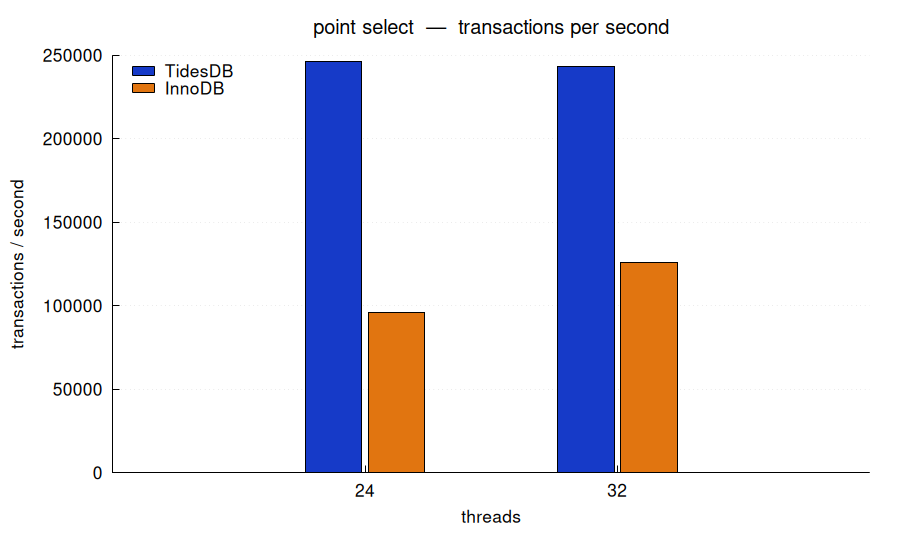
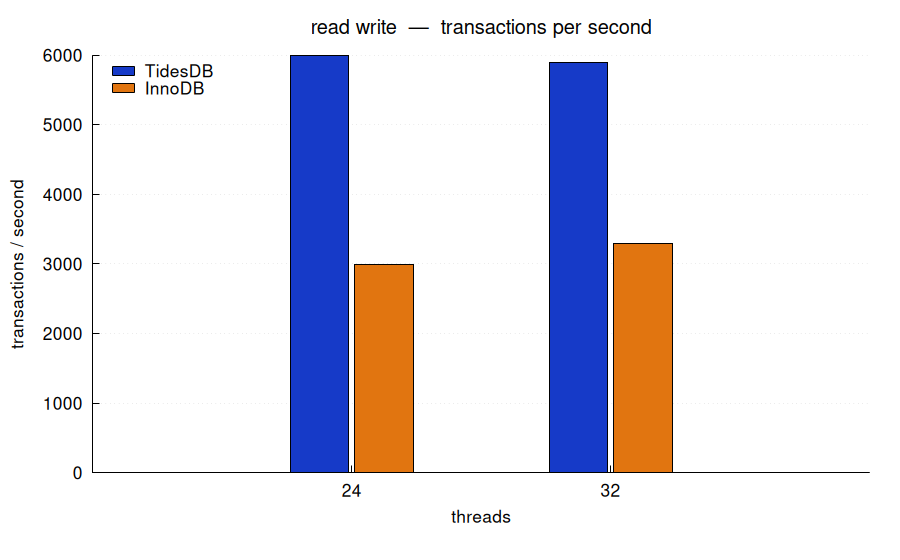
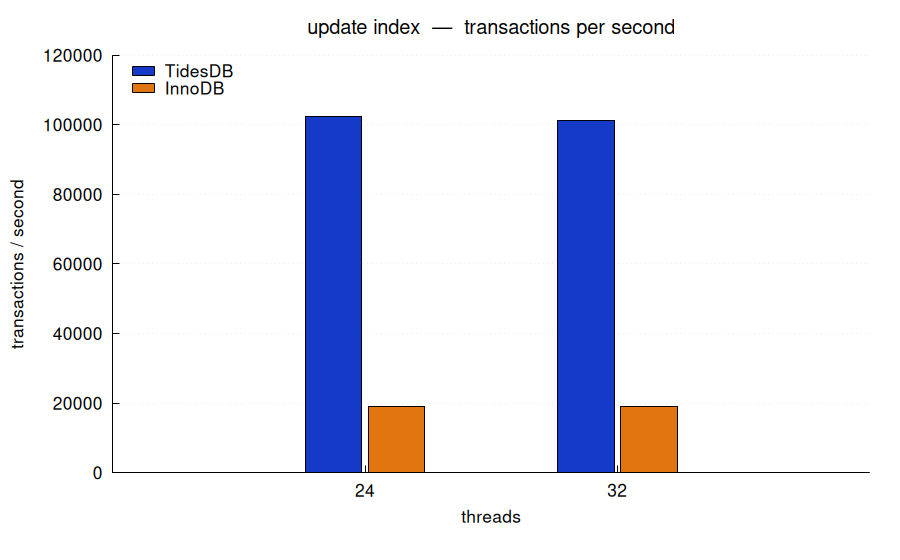
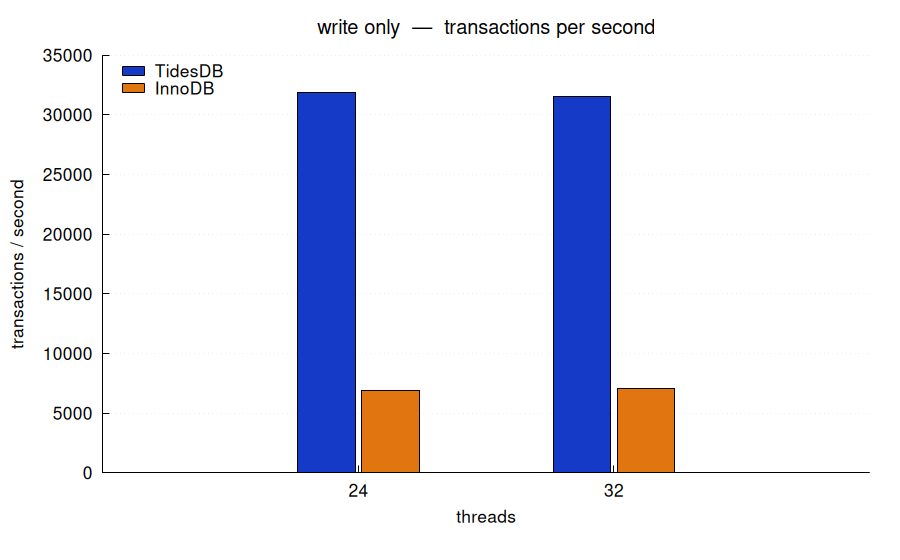
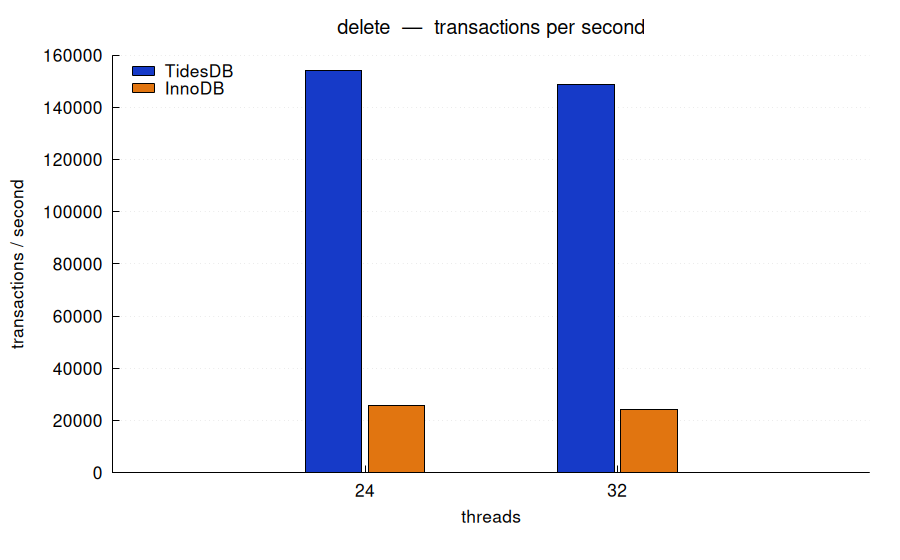
Below is bytes written to the device per operation. These come from /proc/diskstats rather than from either engine’s own accounting, so both are measured the same way beneath the engine, and each run is followed by a settling period so that writes an engine defers are still charged to the run that caused them.
| workload | TidesDB | InnoDB | advantage |
|---|---|---|---|
| read write | 11,196 B | 192,741 B | 17x less |
| update index | 3,000 B | 56,461 B | 19x less |
| write only | 9,290 B | 155,398 B | 17x less |
| delete | 916 B | 42,910 B | 47x less |
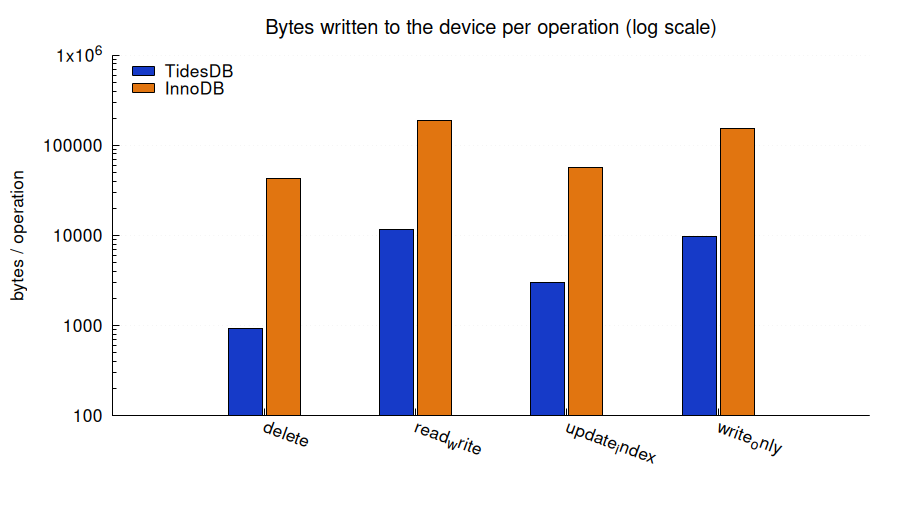
So why such a difference? The dataset is about 8 GB against the 256 MB block cache and 256 MB memtable TideSQL ships with, and InnoDB’s 128 MB buffer pool, so neither engine is holding it in memory. An InnoDB update of a random row has to find a 16 KB page that is usually not resident, read it, change it and write all 16 KB back through the doublewrite buffer with redo on top. TidesDB meanwhile appends a few hundred bytes and sorts it out later.
None of the standard sysbench workloads touch the value log. An sbtest row is about 188 bytes and a value only goes to the log at 1024 bytes or more, so every workload above stays in the key logs. Large values are really what the design is for, thus I ran a separate script against 4 tables of 200,000 rows with a 4 KB text column, built out of a small vocabulary of field names and words so it compresses the way a log line or a JSON document does rather than the way random digits do. I ran three configurations, the third being TidesDB with keep_values_inline set, which holds every value in the key log whatever its size. That third one is a control. Without it a gap between TidesDB and InnoDB could be anything about the engine, whereas with it the value log is the only thing that changed.
| 4 KB values | TidesDB | TidesDB inline | InnoDB |
|---|---|---|---|
| insert | 100,613 | 32,330 | 32,562 |
| select | 255,606 | 74,996 | 98,979 |
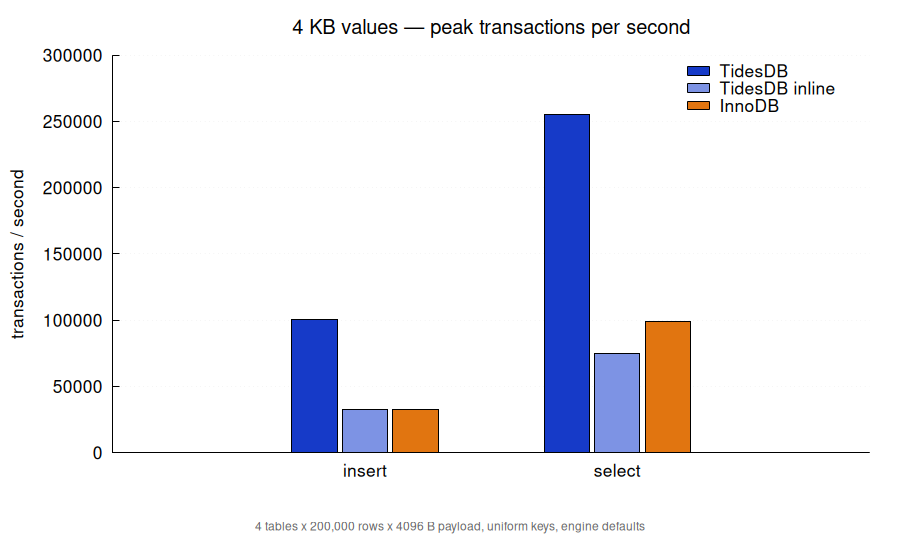
Inline and InnoDB land on the same insert number, and value separation is three times both. So the gain on large writes is not that this is an LSM but that compaction rewrites the keys and leaves the values where they are. The reads show the same thing from the other direction, though do note the table above is throughput while what follows is latency. A 4 KB value held in the key log means few rows to a page, and while inline has the fastest median read of the three at 0.07 ms, its average is 0.38 ms and its worst case is over 40 ms, because compaction is hauling those values around underneath the reads. The default averages 0.09 ms with a worst case of 6 ms.
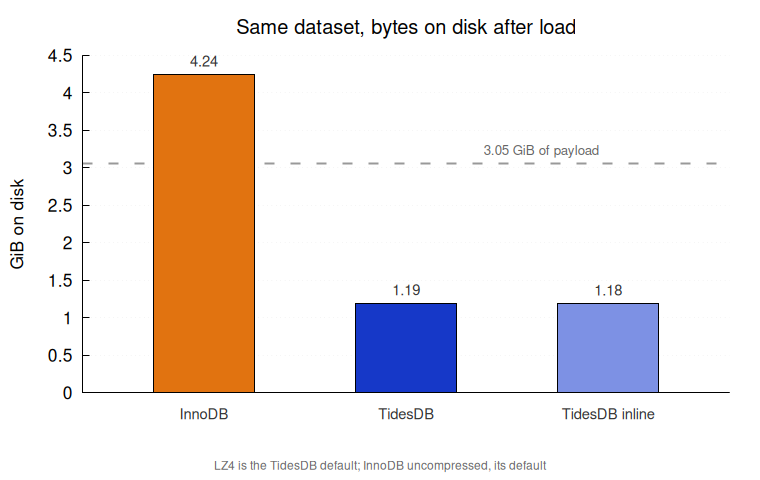
The same 3.05 GiB of payload lands as 4.24 GiB on InnoDB and 1.19 GiB on TidesDB, which is LZ4 at defaults on data that compresses like text. Loading it took InnoDB 17 seconds against TidesDB’s 8.
That’s all for this article, do give TideSQL for MySQL a try!
Raw data and scripts: data.zip (sha256: 95fec38d5b14dc9673f1c5b3351f0cb0f469c8c7a6c584428b064c8a1a96fa2e)